
One small pump for man…one giant pump for mankind!

Tiny Supa-Stelth 46mm impeller pump
New Fluid Tech Technology Pty Ltd
Supa-Stelth Pumping Revolution
Pumps are the second-largest consumer of electricity worldwide, accounting for over 10% of global usage—second only to heating and ventilation (HVAC). In an industry ripe for innovation, New Fluid Tech Technology Pty Ltd has developed a transformative solution that dramatically improves pump efficiency, size, and energy use.
In collaboration with the PRC at the National Agricultural Laboratories in Beijing, on December 16, 2024, we successfully demonstrated a radical innovation: a small 100 mm (4inch) impeller pump operating at higher-than-conventional RPMs (5300rpm) achieved performance equivalent to seven traditional pumps in series. It delivered 50,000 litres per hour to a height of 75 m or 272 feet—without stall or cavitation.
Building on that milestone, in March and April 2025, we engineered a further breakthrough: a thumb-sized impeller of just 46 mm diameter (1.65inch). Operating at over 6,000 RPM, it delivered 6,000 litres per hour at 27m or 90 feet of head pressure—again, without cavitation. This defies traditional pump theory, which says higher RPMs and smaller sizes should lead to inefficiency and cavitation. But not with our technology.
The core innovation lies in our patented use of Solid Body Vorticity (SBV)—a flow pattern that creates a self-contained vortex inside the pump chamber. This vortex encapsulates the impeller, eliminating the cavitation and energy losses caused by turbulent fluid collisions at impeller tips. The result is not just efficiency, but silence: aside from motor noise, our “Super-Stelth” pumps are virtually noiseless.
Unlike traditional pumps that rely on diffusers or volutes to achieve pressure gain, our pumps use firstly centrifugal force from high RPM to create pressure. Then this is increased further via fluid transitioning through a invisible dynamic wall into a statically formed lower pressure zone that acts similar to a diffuser.
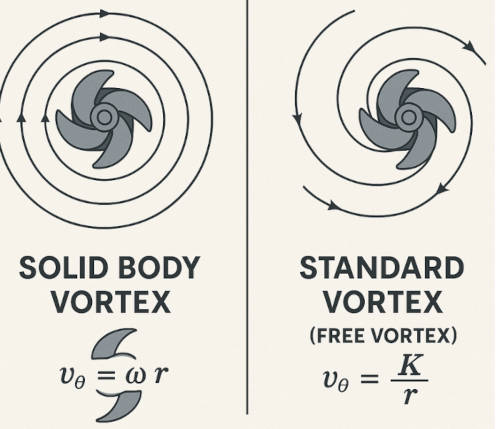
The energy savings are profound—30% to 50% lower power consumption. Moreover, while conventional pumps follow affinity laws (with power increasing by a factor of eight when RPM doubles), our SBV pumps only increase power by around a factor of five. This is because efficiency increases with speed — another counterintuitive but proven result.
Physics is on the side of small high speed pumps
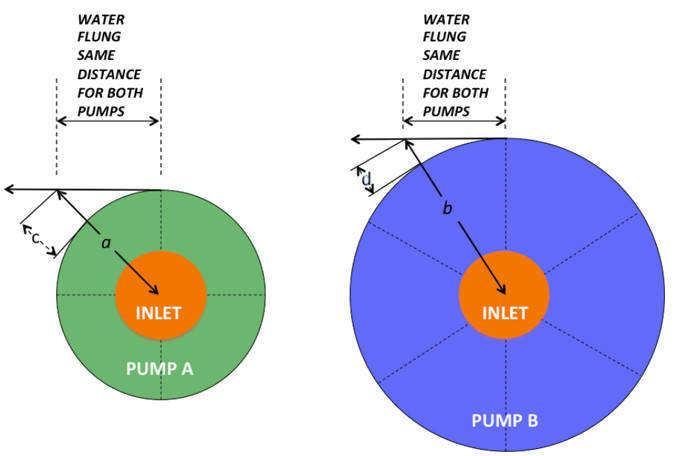
Distance a in pump A is shorter than distance b in pump B. At the same periphery speed, periphery of pump A has receded distance c while periphery of pump B has receded distance d. The larger rate of recession of pump A (61.5%) represents a larger acceleration generating much larger force. 1.615 squared = 2.6 times dynamic pressure from pump A over pump B, much of which is converted to static head.
For same water speed for pumps A and B,
- “a” is less distance than “b”. Water is accelerated through a shorter distance.
- “c” is further than “d”. This is a greater acceleration off the impeller.
Acceleration is the source of all force. Larger acceleration results in larger force.
Cost of variable speed BLDC motors is more than offset by the lower cost of the small size Stelth pump running at high RPM and the physically smaller motor. Far lower running costs re-coup investment quickly. It enables a tiny, energy dense package. This also means that running small Stelth pumps in parallel and or series has great advantages.
What we have developed is a compact, high-speed, ultra-efficient pump capable of replacing complex multistage pump systems. It delivers industry-leading litres per watt performance, sets a new standard in noise reduction, and allows for radically smaller, lighter, and cheaper pump units. The implications for agriculture, industry, and infrastructure are enormous.
Farmers, gardeners, and industrial users alike will benefit from the energy efficiency, performance, and cost advantages of this revolutionary design. At a time when every watt matters, New Fluid Tech’s Super-Stelth technology redefines what pumps can do—and how sustainably they can do it.
Pools are a good example of a "fluid system" attached to a pump
A Revolution in Pool Pump Efficiency: The Future is Here!
New Fluid Technology is set to transform the global pool and spa pump industry with a breakthrough that redefines how pump efficiency is achieved.
Traditional pool pumps often operate as “big pumps doing small work” by significantly reducing the RPM of large impellers—typically from 3000 RPM down to below 1000 RPM. This approach is based on the Affinity Laws, where halving the RPM reduces power consumption by a factor of eight. While this method can reduce energy use, especially when the goal is simply to turn over pool water twice every 24 hours, it comes with a hidden cost: dramatic loss of pump efficiency.
In fact, detailed analysis reveals that while power consumption drops, pump efficiency itself falls from around 50% to as low as 8%. This means the energy savings aren’t coming from the pump's performance, but rather from reduced friction losses within the pool’s filtration system. The filtration system doesn’t care about the size or speed of the pump—it only requires sufficient head and flow to function effectively.
New Fluid Technology’s solution flips the traditional model on its head. By increasing RPM above conventional levels—rather than reducing it—we achieve pump efficiencies of over 80%, a level previously thought impossible with any known pump configuration. This is made possible by a unique design feature: a solid-body vortex that fully encapsulates the impeller tips. This innovation eliminates cavitation caused by blade tip stall, a common inefficiency in standard pump designs.
This paradigm shift exposes a critical flaw in the long-held assumption that “bigger is better.” In reality, smaller, high-efficiency pumps—properly engineered—can outperform their larger counterparts in both energy use and reliability.
The result is a revolutionary advancement in pool and spa pump technology. This is not just an incremental improvement—it's the future of sustainable, high-performance water circulation.
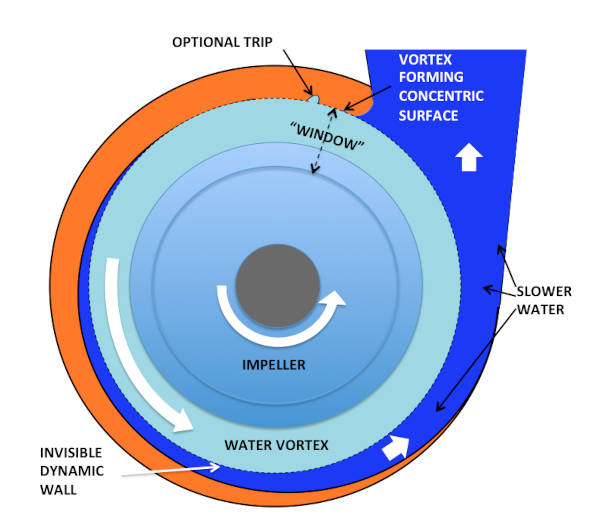
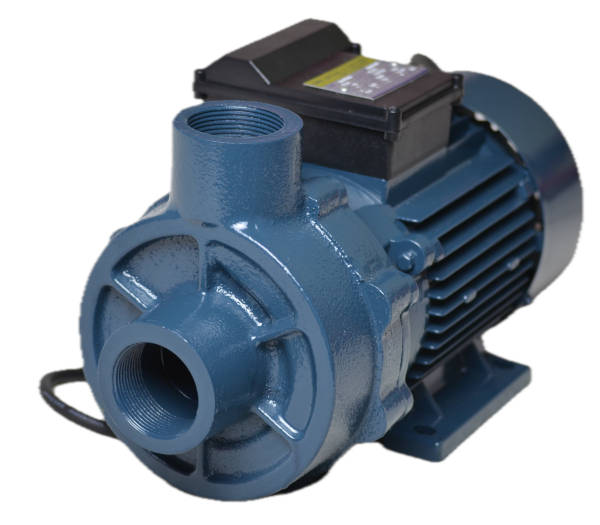
Conventional speed Supa-Stelth pumps (as above) have superior performance also
WHY SMALLER IS BETTER
There are three key reasons why smaller impellers can offer significant performance advantages, especially in the context of the Supa-Stelth high-efficiency water vortex pump.
1. Smaller Impellers Generate Higher Pressure at the Same Tip Speed At identical tip speeds, smaller diameter impellers can produce higher pressure than their larger counterparts. This principle is why turbochargers—though designed to move air—use very small impellers spinning at extremely high RPMs (often exceeding 100,000 RPM). The underlying physics is shared: smaller impellers achieve higher acceleration at the periphery.
To understand why, consider that the edge of a small circle departs from a tangent line more quickly than the edge of a large circle. This rapid departure means fluid flow separates faster at the impeller’s periphery, resulting in a sharper acceleration and thus a greater force imparted to the fluid.
Because acceleration is the foundation of force, a quicker acceleration results in greater dynamic pressure. In the Stelth pump, this dynamic pressure is efficiently converted into static pressure by a specially designed low-speed diffusion zone soon surrounding the high-speed vortex. As a result, a smaller impeller operating at the same tip speed can drive a higher pressure and potentially a greater flow rate, often with improved efficiency.
While increasing RPM in conventional centrifugal pumps does little without upsizing the pump itself, the Stelth pump’s vortex design thrives on high RPMs—creating a new performance frontier for pump technology.
2. Smaller Size Improves Surface Area-to-Volume Ratios The second advantage of a smaller pump lies in fundamental geometry. When an object’s dimensions are scaled, its surface area and volume do not increase proportionally. For example, doubling the diameter of a sphere increases its surface area by a factor of four, but its volume by a factor of eight.
This disparity imposes practical limits on the size of conventional pumps—beyond a certain diameter (around three meters), there simply isn’t enough external surface area to accommodate inlet and outlet ports proportional to the pump’s internal volume.
By contrast, the Stelth pump capitalises on this geometric principle in reverse. Its compact size—combined with high RPM operation and the high-efficiency performance of its amorphous motor—enables exceptional output from a small footprint. As the pump gets smaller, the surface area relative to its internal volume increases, which is typically a disadvantage for conventional designs. But for the Stelth, this ratio enhances pressure generation, flow rate, and overall efficiency.
3. Conventional Pumps Require Size Increases to Improve Performance In traditional centrifugal pump design, performance improvements typically require physical upsizing—increasing diameter and mass to deliver more pressure and flow. In contrast, the Stelth achieves greater output not through size, but through speed, geometry, and efficiency.
The result is a disruptive evolution in pump technology—where smaller, high-speed pumps outperform larger conventional ones across key performance metrics surrounding the high-speed vortex. As a result, a smaller impeller operating at the same tip speed can drive a higher pressure and potentially a greater flow rate, often with improved efficiency.
While increasing RPM in conventional centrifugal pumps does little without upsizing the pump itself, the Stelth pump’s vortex design thrives on high RPMs—creating a new performance frontier for pump technology.