
Jetfan™ — A Step Change in Fan Technology
From drones and jet turbines to appliances and defence systems
New Fluid Tech was founded on a simple but radical idea: to rethink fluid behaviour from first principles — not just in water pumps (where our Solid Body Vortex™ technology has already delivered world-leading results), but across all moving-fluid systems.
One of the most profound outcomes of this work is Jetfan™ — a fan architecture that challenges assumptions engineers have held for over a century.
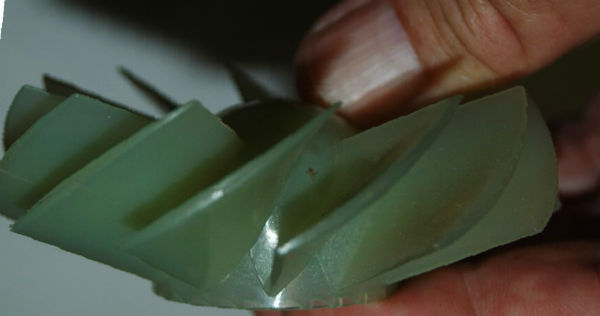
At first glance, Jetfan looks deceptively simple: overlapping blades, mouldable geometry, compact form. Yet this design cannot currently be manufactured by anyone else without our cooperation — including organisations with access to the world’s most advanced production capabilities, including United States DOD.
That alone should invite curiosity. The performance implications demand investigation.
Why Jetfan Is Different
1. Stall-free operation
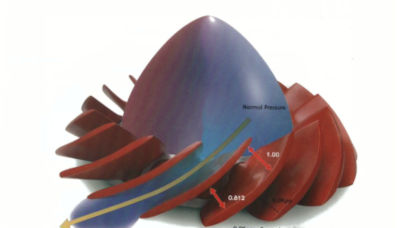
Conventional fans stall — flow separates from the blades, efficiency collapses, noise rises, and pressure gain stops. Jetfan’s geometry eliminates stall entirely, allowing RPM, pressure, and flow to increase linearly and predictably. In small diameters, outlet velocities approaching sonic levels have already been observed.
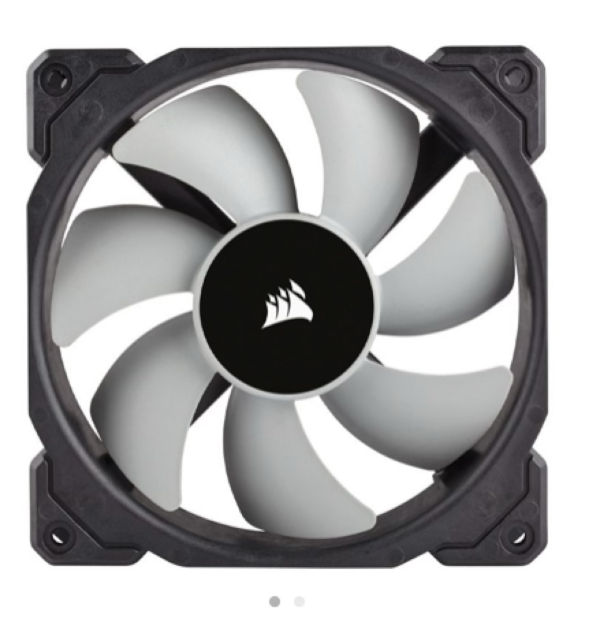
Traditional cooling fan with non-overlapping blades
2. Radical size reduction
In most conventional fans, nearly all useful work occurs in the outer 10% of blade diameter. The rest contributes little but drag and noise. Jetfan activates the entire swept area, meaning equivalent performance can be achieved with dramatically smaller rotors — often exponentially smaller.
3. Straight, high-pressure discharge
Jetfan blades overlap and converge at the tips, compressing air internally while eliminating blade-tip vortex losses. The result is something highly unusual in fan systems: high-pressure air exiting into a high-pressure zone — clean, straight, and low-turbulence, without the need for downstream stators.
4. Mass manufacturable
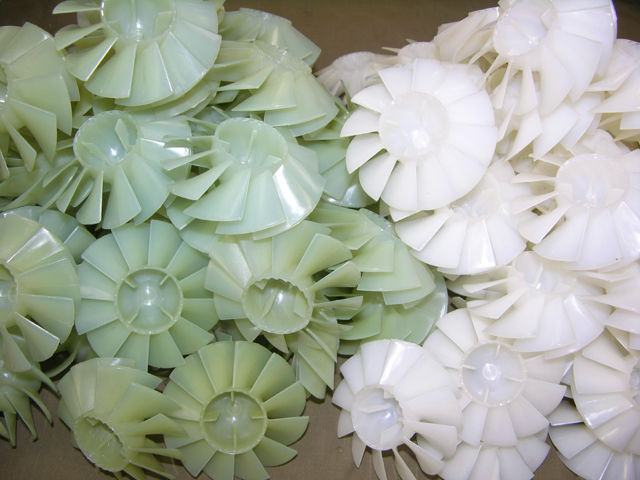
Despite overlapping blades — long thought incompatible with moulding — Jetfan can be mass-produced as a single moulded component, enabling cost-effective deployment across consumer, industrial, aerospace, and defence sectors.
5. Jet Fans Make almost No Noise
Jet fans make almost no noise. The reasoning is that compressing the air between the foils reduces turbulence thereby reducing sound.
Why This Matters to Engineers
Most fans are selected using performance curves generated in laboratory ducts often exceeding 6 metres in length, with flow controlled by calibrated restriction plates. Yet real-world systems — drones, cooling systems, appliances, medical devices — do not operate in long ducts. They operate in confined, turbulent, highly constrained environments where fan stall and efficiency collapse are routine but poorly recognised.
Conclusions of an Australian University Testing
Conclusions of an Australian University Tests
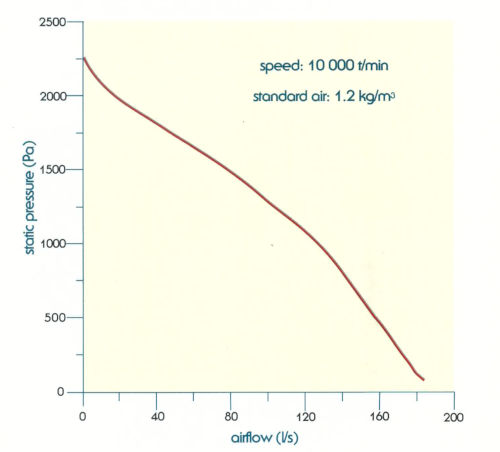
The static pressure versus flow rate data produced maybe compared to the performance curves of current commercially available fans operating within their design speed range, typically below 3000 RPM. For the range of flow rates under 200 L per second the Jetfan produces a static pressure above 5000 Pa, this may be compared to typical axial fans of the same size which produce up to 150 Pa, and centrifugal fans which typically produce up to 300 Pa. Larger axial fans of 300 mm diameter typically produce up to 750 PA static pressure, increasing to 1500 Pa for 600 mm diameter fans, and large 600 mm diameter centrifugal fans typically produce up to 1000 Pa.
Thus for a required flow rate under 200 L per second the 130 mm Jetfan impala produces static pressure more than 10 times higher than conventional fans of similar dimensions, and up to 3 times more pressure than larger conventional fans (600 mm impellers) when such conventional fans are operated at their design speeds. Higher static pressures may be obtained by operating conventional impellers above their design speed range however this will usually result in a large decrease in efficiency..
The Jetfan is consequently ideally suited for applications requiring a minimal sized impeller such as in domestic appliances and for applications requiring a large static pressure such as High head water pumps, water jets for marine propulsion, and air blowers for high resistance ducting typical of high-rise buildings or conveyor system air ducts.
The Jetfan may be further developed as a multi stage fan or compressor as the static pressure measurements were made immediately behind the impeller blades, before any stators or diffusors and thus all of the measured static pressure is available for the inlet to a second stage impeller directly behind the first impeller.
The suction performance of the Jetfan measured in Test to demonstrates the suitability of the Jetfan as an impeller for a vacuum cleaner generating a vacuum of 28,800 Pa below atmospheric pressure while drawing 183 L per second through a 32 mm diameter pipe.
The direct comparison of the Jetfan to a 230 mm diameter centrifugal fan in Test three at similar power input demonstrates the superior efficiency of the Jetfan which produces greater Head,9 static pressure) while drawing 183 L per second through a 32 mm diameter pipe.
The direct comparison of the Jetfan to a 230 mm diameter centrifugal fan in Test three at similar power input demonstrates the superior efficiency of the Jetfan which produces greater Head (static pressure) and greater flow rate than the larger centrifugal fan for the same electrical input power. Typical small axial and centrifugal fans of diameter under 300 mm do not have the level of efficiency of larger fans., thus the Jetfan is ideally suited to applications requiring small impeller size and High efficiency.
Implications for Jet Engines and Compressors
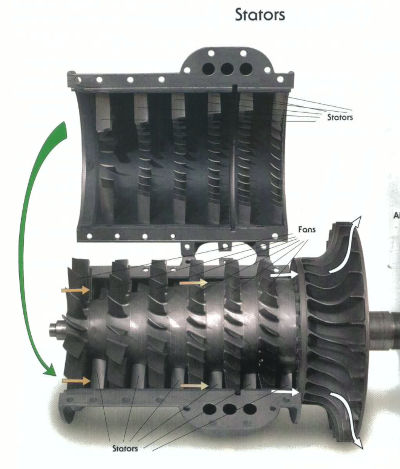
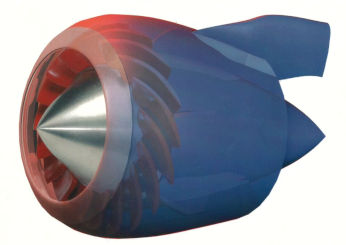
Modern jet engines rely on many compressor stages with interstage stators to recover swirl and build pressure progressively. Jetfan’s stall-free, internally compressive flow structure suggests that multiple stages could be eliminated, compressor length dramatically shortened, and overall efficiency increased — with corresponding reductions in mass, noise, and mechanical complexity.
Even Conventional Fans Could Improve Immediately
Even adopting overlapping-blade geometry at the hub alone — without full Jetfan architecture — would increase conventional fan efficiency by at least 15%, simply by eliminating hub stall, one of the most pervasive hidden losses in rotating machinery.
In Summary
Jetfan delivers something no other known fan technology can:
- Absolute stall-free performance
- High pressure and high flow from dramatically smaller diameters
- Straight, low-turbulence discharge without stators
- Mass manufacturable geometry
- Scalable from drones and appliances to turbines and industrial systems
This is not an incremental improvement. It is a structural shift in how fans and compressors can be designed
At New Fluid Tech, we are open to collaboration with organisations committed to serious technical evaluation and mutual advancement — particularly in aerospace, defence, energy, and advanced manufacturing.
If the assumptions behind fans have not changed in 100 years, perhaps it is time they did.